
Credential & Compostela
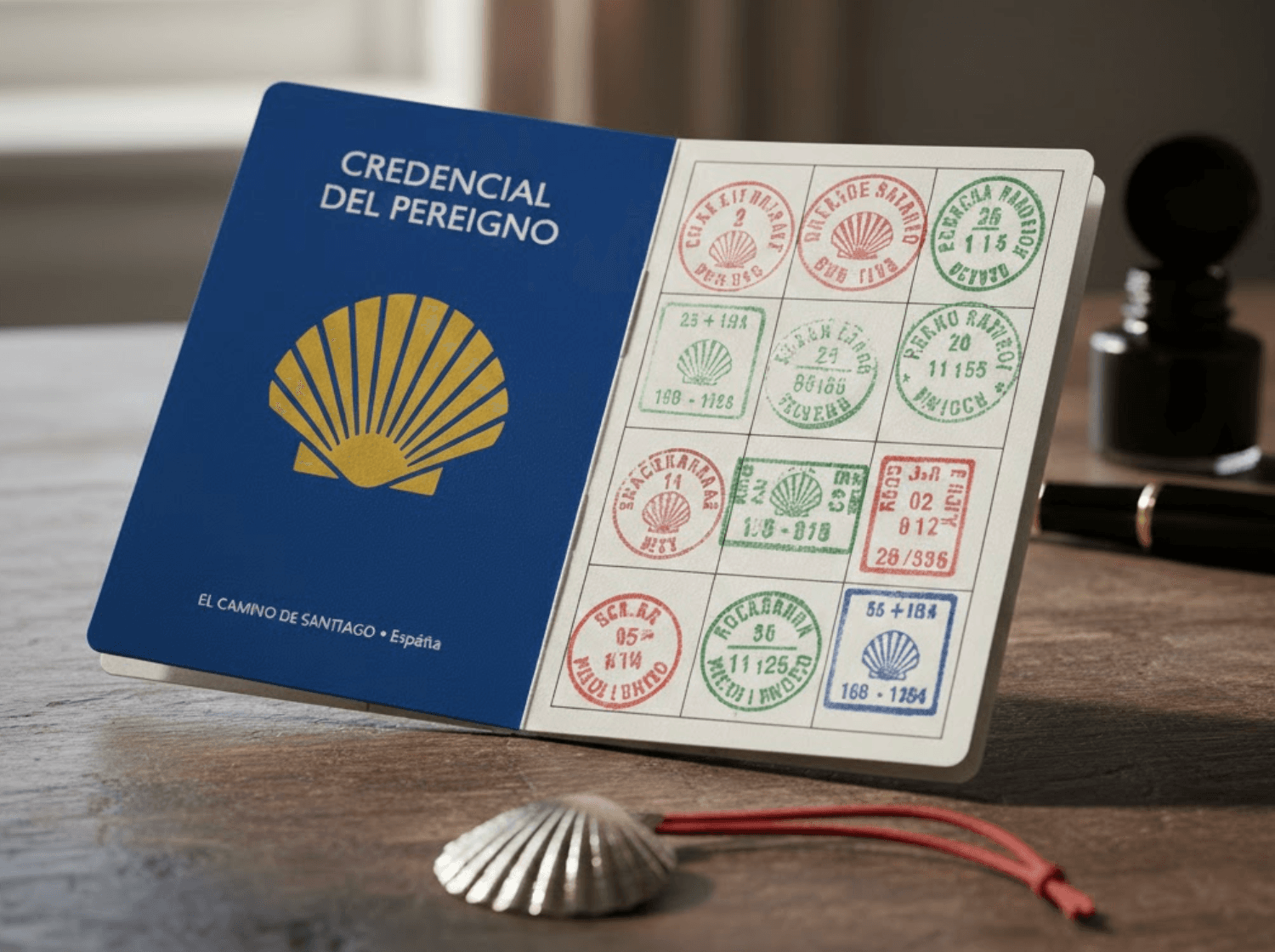
One of the most distinctive aspects of the Camino de Santiago is that it is not just a long walk — it is an officially recognized pilgrimage with its own symbols, traditions, and documentation. The pilgrim credential, the daily collection of stamps, and the Compostela certificate connect today's pilgrims with centuries of history while providing a simple system that still works remarkably well. This guide explains what the pilgrim credential is, where to get one, how stamps work, and what is required to receive the Compostela in Santiago.
What Is the Pilgrim Credential?
The pilgrim credential (known in Spanish as the credencial del peregrino) is a small booklet that functions as a pilgrim passport. It identifies you as an official pilgrim walking the Camino de Santiago.
At its most practical level, the credential serves three main purposes: it proves that you are walking the Camino as a pilgrim, it allows access to pilgrim accommodations (especially public albergues), and it records your journey through stamps collected along the way. But beyond logistics, the credential is also a symbolic object. It becomes a personal record of your Camino — filled with dates, places, and stamps that tell the story of your walk.
Historical Origins of the Credential
The idea of documenting a pilgrimage dates back to the Middle Ages. Historically, pilgrims carried letters or documents that proved their status, granting them hospitality, protection, and access to pilgrim hospitals and shelters. These early documents evolved over time into what we now recognize as the modern credential. While today's version is simpler and standardized, it preserves the same spirit: recognition, trust, and shared tradition.
Who Can Use the Credential?
Anyone walking, cycling, or riding the Camino for pilgrimage purposes can use a credential. There is no requirement to be religious, Catholic, or even spiritual. The Camino recognizes that pilgrims walk for many reasons: religious, spiritual, cultural, personal, or reflective. What matters is that you are making the journey on foot, by bicycle, or on horseback, following the Camino routes.
Credential vs Tourist Documents
It's important to understand that the credential is not an ID document, a visa, a replacement for a passport, or a general tourist card. Your regular passport or ID is still required for travel and accommodation check-ins. The credential exists only within the Camino context and serves a very specific purpose related to pilgrimage recognition.
Where to Get the Pilgrim Credential
Pilgrim Associations
Pilgrim associations are one of the most reliable sources. These organizations exist worldwide and support Camino pilgrims by providing credentials, information and guidance, and community and preparation resources. Many pilgrims prefer getting their credential from an association because it creates a sense of connection even before starting.
Churches
Many churches along Camino routes distribute credentials, especially in traditional starting towns. This reflects the Camino's historical and religious roots.
Albergues
Some albergues — especially at common starting points — sell or issue credentials. This is a convenient option if you arrive without one.
Camino Starting Points
Popular starting towns often have official locations where credentials are available, such as pilgrim offices, tourist information centers, and Camino-specific welcome points.
Online Options
Some pilgrim associations and Camino organizations offer credentials by mail. This is especially useful if you want to arrive fully prepared, you are starting in a less common location, or you want peace of mind before traveling.
Getting a Credential Outside Spain
Pilgrims starting outside Spain — in France, Portugal, or other countries — can usually obtain credentials locally through national pilgrim associations, churches, or Camino organizations. If you plan to start far from traditional Camino hubs, it's best to arrange your credential in advance.
Replacement if Lost
Losing your credential is stressful, but it's not the end of the Camino. If this happens, visit a pilgrim association, albergue, or church, explain the situation, and bring identification if possible. You may receive a replacement credential, although stamps already collected cannot usually be recovered. Some pilgrims write notes explaining where they walked, but acceptance depends on the Pilgrim's Office.
Multiple Credentials on One Camino
It is technically possible to use more than one credential on a single Camino, but this can cause confusion — especially when applying for the Compostela. If you do need to switch credentials, keep both and present them together in Santiago.
How Stamps Work
Daily Stamp Collection
As you walk, you collect stamps in your credential. One stamp per day is required in most sections of the Camino. In the final 100 km before Santiago, the requirement increases to two stamps per day. This rule exists to confirm that pilgrims are genuinely walking the final stretch and not skipping sections.
Where to Get Stamps
Stamps are widely available and easy to find. Common places include albergues, bars and cafés, churches, tourist offices, police stations, and town halls. Many establishments proudly offer stamps, even if you don't stay or eat there.
Fun and Unique Stamps
Stamps are not standardized, and that's part of the fun. Some are artistic, humorous, handmade, or unique to a specific village or bar. Over time, your credential becomes a colorful and deeply personal souvenir.
Digital vs Physical Stamps
With the rise of apps and digital tools, there has been discussion about digital credentials and stamps. However, the official system still requires physical stamps, digital records are not accepted for the Compostela, and physical stamps remain part of the Camino's tradition and identity. For now, stamps are something you collect with ink, not with a phone.
Common Stamp Mistakes
Some common issues to avoid: forgetting to stamp every day, only collecting one stamp per day in the final 100 km, stamps without a date, or illegible stamps. While Pilgrim's Office staff are generally understanding, missing or unclear stamps can cause delays or complications.
Compostela Requirements
Minimum Distances
The Compostela is the official certificate issued by the Cathedral of Santiago de Compostela confirming that you completed the pilgrimage. To be eligible for the Compostela, pilgrims must complete at least 100 km on foot or at least 200 km by bicycle. These distances must be continuous and follow recognized Camino routes.
Walking for Religious or Spiritual Reasons
Traditionally, the Compostela was issued only to pilgrims who walked for religious or spiritual reasons. Today, pilgrims are asked to state their motivation when applying. Most pilgrims select religious, spiritual, or a combination of both. Those who walk purely for sport or tourism may still receive a Certificate of Distance, but not the Compostela.
Rules Enforced by the Pilgrim's Office
The Pilgrim's Office in Santiago verifies your credential and stamps, the route walked, the minimum distance, and stamp frequency in the final section. Rules are applied consistently, and staff are experienced in reviewing thousands of credentials every day.
What Happens at the Pilgrim's Office
When you arrive in Santiago, you go to the Pilgrim's Office, present your credential, staff review stamps and dates, you state your motivation, and your Compostela is issued if eligible. During busy seasons, waiting times can be long, so patience is important.
Compostela vs Certificate of Distance
There are two main documents pilgrims may receive: the Compostela for religious or spiritual pilgrimage, and the Certificate of Distance, which confirms the route and distance walked regardless of motivation. Some pilgrims choose to receive both.
Name Spelling and Latin Version
The Compostela is written in Latin, and your name may appear in a Latinized form. This is traditional and normal. If name accuracy matters to you, inform the staff when applying.
More Than Paper and Stamps
The credential and Compostela are practical tools, but they are also symbols of belonging. They connect you to millions of pilgrims who have walked before you — and to those who will come after. The Camino doesn't require perfection. Stamps may blur, plans may change, and motivations may evolve. What matters is the journey itself. The credential simply tells its story.
Buen Camino.