
History of the Camino de Santiago
The Camino de Santiago is not just a physical route; it is a journey through centuries of history, faith, culture, and tradition. Understanding its history adds deep meaning to every step, every albergue, and every yellow arrow along the way. This article explores who Santiago is, how pilgrimages began, and how the Camino became a unique cultural network across Europe.
Who is Santiago?
Santiago in Christian Tradition
Santiago, also known as St. James the Greater or St. James the Apostle, was one of Jesus' twelve disciples. His figure is central not only to the Camino but also to Spain's religious and cultural history. According to tradition, Santiago preached on the Iberian Peninsula after Jesus' death. After his martyrdom in Jerusalem, his remains were believed to have been transported to Galicia, where they rest in the cathedral of Santiago de Compostela. His tomb became a site of devotion and pilgrimage as early as the 9th century. For Christians, Santiago represents unwavering faith, protection in the face of adversity, and spiritual guidance in difficult times.
Santiago as a Cultural Symbol
Beyond his religious significance, Santiago is also a symbol of Spanish cultural identity. His figure appears in literature, coats of arms, and works of art from the Middle Ages to the present. He embodies the intersection of history, religion, and tradition in Spain.
Santiago Matamoros
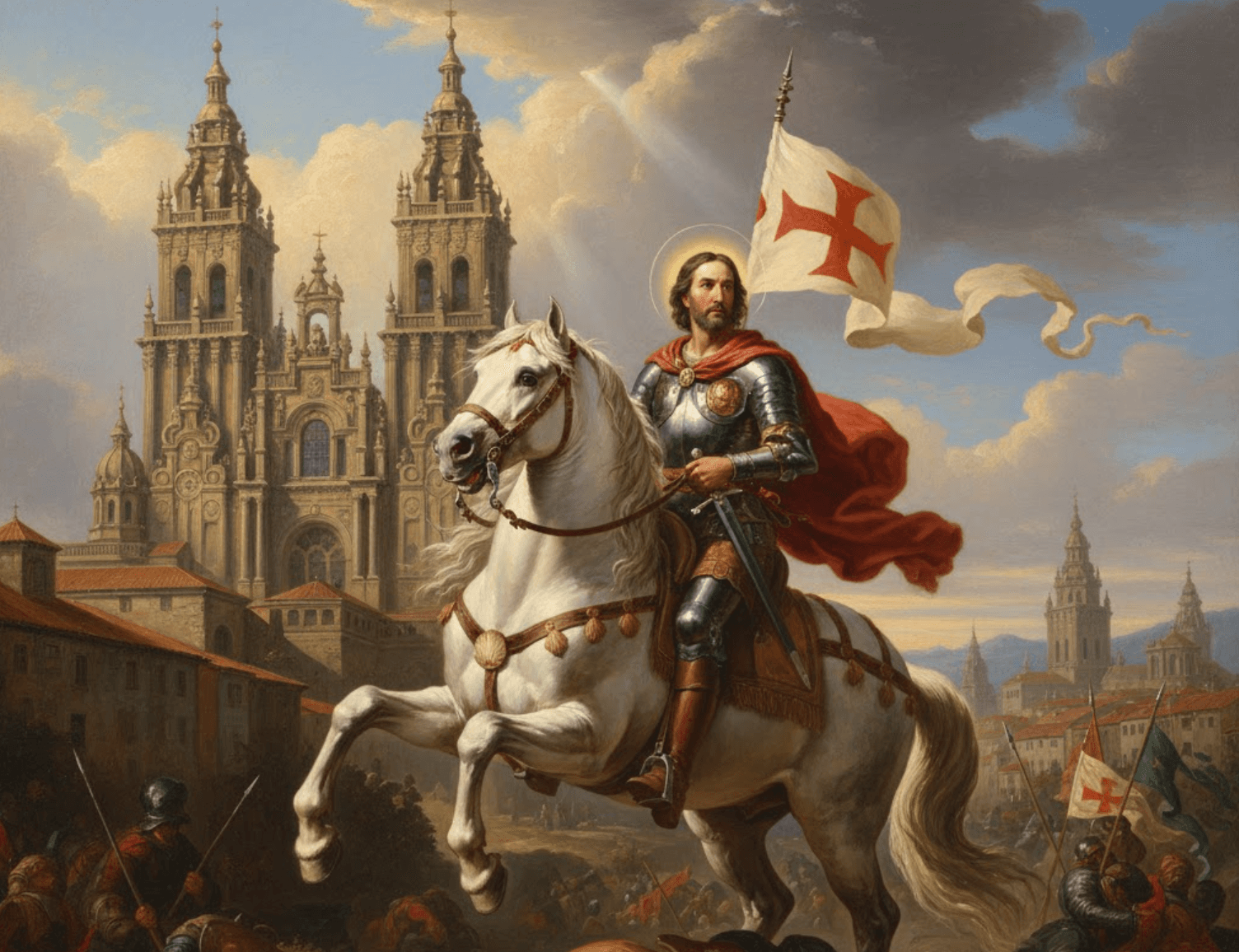
One of the best-known depictions of Santiago is "Santiago Matamoros", a warrior defending the Christian faith during the Reconquista. This image originated in the Middle Ages and symbolizes the protection of Christian kingdoms against invaders. While now largely a historical symbol, Santiago Matamoros still appears in sculptures, paintings, and celebrations.
Iconography of Santiago
Santiago is typically represented with a pilgrim's staff, a wide-brimmed hat, a scallop shell (symbol of the pilgrim), and a sword in the Matamoros version. These elements not only identify him but have also become universal symbols of the Camino de Santiago.
Santiago in Spanish History
Over the centuries, Santiago played a key role in consolidating Christian identity in the Middle Ages, inspiring literature and the arts, and serving as a spiritual and cultural reference. From his tomb to representations in plazas and cathedrals, Santiago remains a meeting point between history and faith.
How Pilgrimage Began
Discovery of the Tomb in the 9th Century
The history of the Camino de Santiago as an organized pilgrimage begins in the 9th century, with an event that would change Galicia and medieval Europe. According to tradition, in 813, Santiago's tomb was discovered in Galicia. This discovery is considered the starting point of the pilgrimage. News of it quickly spread across Europe, and soon pilgrims began arriving from all corners of the continent. The construction of the first church over the tomb laid the foundation for what would become the Cathedral of Santiago de Compostela.
Medieval Pilgrimage Routes
During the Middle Ages, multiple routes to Santiago emerged, creating a network connecting European cities and monasteries with Galicia. These routes facilitated not only physical travel but also cultural exchange, trade development, and networks of protection and hospitality for pilgrims. Some medieval routes still exist today as part of the traditional Camino.
The Role of Monasteries and Kings
Monasteries, churches, and convents played a fundamental role: providing accommodation and food for pilgrims, serving as centers of guidance and information, and protecting travelers. Kings and nobles also promoted the Camino, funding infrastructure and creating safe routes. Their support helped establish the Camino as a stable and recognized pilgrimage network.
The Camino as Europe's First Cultural Network
At its height, the Camino de Santiago was much more than a religious journey. It connected cities, villages, and monasteries across countries, facilitated the exchange of knowledge, art, and culture, and became Europe's first pan-European cultural network, like a highway of ideas and traditions. The Camino served as a vehicle for artistic, architectural, and literary diffusion, influencing all of Europe.
The Golden Age of Pilgrimage
Between the 11th and 13th centuries, pilgrimage experienced its golden age. During this period, thousands of pilgrims arrived in Santiago each year, the city and its cathedral expanded to accommodate the faithful, bridges, roads, and hospitals were built, and codices, maps, and guides emerged for travelers. The Camino's fame extended beyond Western Europe, becoming a worldwide reference for pilgrimage.
Decline and Rebirth of the Camino
From the 16th century onward, several factors led to a decline in pilgrimage: wars and political conflicts, religious changes such as the Reformation and Counter-Reformation, and disease and deterioration of routes. However, in the 20th century, a renaissance began, fueled by cultural and tourist movements, renovation of albergues and routes, and increased interest in historical and religious heritage. Today, the Camino de Santiago enjoys a new surge in popularity, attracting pilgrims from around the world.
The Role of UNESCO
In 1993, UNESCO declared the Camino de Santiago a World Heritage Site, recognizing its historical and cultural value, its role in art and architectural history, and its influence on European identity. This international recognition has helped preserve routes, monuments, and traditions, ensuring future generations can experience the Camino as medieval and modern pilgrims have.
The Camino as a Historical Experience
Knowing the history of the Camino transforms the walk into something more than physical exercise or tourism. Every albergue, church, and yellow arrow tells centuries of stories of faith, solidarity, and shared culture. While walking the Camino, you follow routes traversed by thousands of pilgrims since the 9th century, uphold traditions that have survived wars, epidemics, and political change, and connect with medieval Europe, its customs, and its architecture. Walking today means being part of a living history, where past and present meet at every stage.
Santiago and the Camino Today
Today, Santiago is much more than a historical or religious figure: he is a cultural symbol of Spain, a spiritual and tourist reference for millions of pilgrims, and an icon connecting history, faith, and modernity. The Camino continues to be a place of encounter: with yourself, with others, with nature, and with history. Understanding its history adds depth and meaning to every step. Each albergue visited, each stamp collected, and each kilometer traveled is better understood in its historical context. The Camino ceases to be just a physical path and becomes a journey through time.
Conclusion
The history of the Camino de Santiago shows that it is not just a trail, but a millennial tradition. From the discovery of Santiago's tomb in the 9th century, through the Golden Age of pilgrimage, to its rebirth and UNESCO recognition, the Camino remains a space for spiritual, cultural, and human connection. Walking the Camino is to traverse centuries of history, experience European heritage, and participate in a shared journey that has transformed the lives of millions of pilgrims. Every step, every stamp, and every stage becomes a link with those who walked before and those who will walk after.
Buen Camino.