
What Is the Camino de Santiago and How Does It Really Work?
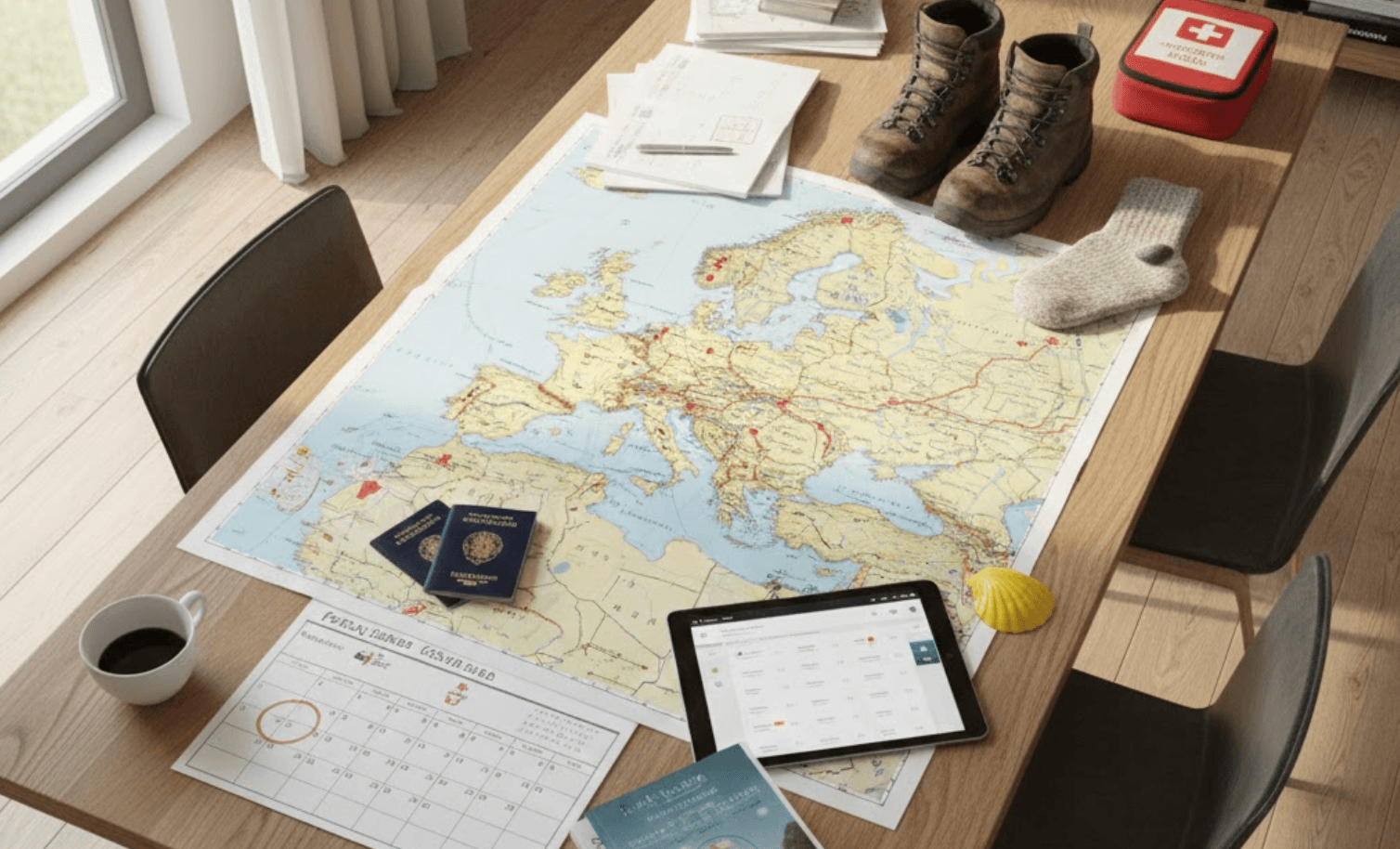
If you've heard people talk about "the Camino" with a mix of emotion, mystery, and enthusiasm, you're not alone. For many, the Camino de Santiago is difficult to explain in a single sentence — because it is many things at once. It is a journey across landscapes and cultures, a centuries-old tradition, a physical challenge, and for many pilgrims, a deeply personal experience. This guide covers the basics: what the Camino is, how it works, the routes that make it up, and how people have traditionally planned their journey.
What Is the Camino de Santiago?
The Camino de Santiago is a network of ancient pilgrimage routes that all lead to the city of Santiago de Compostela, in northwestern Spain. According to Christian tradition, Santiago is the burial place of Saint James the Apostle, one of Jesus' closest disciples. For over a thousand years, pilgrims from across Europe — and later the world — have walked these paths to reach the cathedral that houses his remains.
Despite its religious origins, the Camino today is open to everyone, regardless of belief, background, or motivation. Some pilgrims walk for faith or spiritual reasons. Others come for cultural curiosity, personal reflection, physical challenge, or simply the desire to slow down and experience life on foot. Many don't know exactly why they are walking until they start.
What makes the Camino unique is that it is both a physical journey and an inner experience. You walk day after day through villages, fields, forests, mountains, and cities. At the same time, the repetitive rhythm of walking creates space for thought, emotion, and connection — with others and with yourself.
Religious and Non-Religious Caminos
Historically, the Camino was a religious pilgrimage, and it still is for many. Pilgrims attend mass, pray along the way, and walk with a spiritual intention. At the same time, a large portion of modern pilgrims describe themselves as non-religious or spiritual-but-not-religious. They may be drawn by the history, the landscapes, or the idea of a long journey without distractions. The Camino doesn't force a single meaning on anyone. Two people can walk side by side for days with completely different reasons for being there — and both experiences are equally valid.
Why People Walk the Camino Today
People start the Camino for many reasons: to mark a life transition (grief, divorce, burnout, retirement), to disconnect from daily stress and reconnect with themselves, to experience simplicity and routine, to challenge themselves physically or mentally, to explore history and culture slowly, to meet people from around the world, or to search for meaning — or simply for silence. Some arrive with big questions. Others arrive with no expectations at all. One of the Camino's defining traits is that it often gives you something different from what you thought you were looking for.
Is the Camino a Hike, a Pilgrimage, or Both?
Technically, you walk many kilometers each day carrying a backpack — so yes, it is a long-distance walk. But the Camino is not just a hike. Unlike typical trekking routes, the Camino passes through living towns and villages, has accommodation, food, and services almost every day, encourages social interaction and shared experience, and has symbolic, historical, and cultural meaning. At the same time, it is not a rigid religious ritual either. The Camino exists somewhere between pilgrimage, journey, and way of life, and each pilgrim defines it differently.
How the Camino Works
Walking from Village to Village
Pilgrims typically walk from village to village or town to town, staying overnight in accommodations along the route. These can include public albergues (simple pilgrim hostels), private albergues, guesthouses and small hotels, and rural homes and pensions. There is no central booking system and no obligation to stay in pilgrim accommodation, though many choose to for the experience.
Waymarking: Yellow Arrows and Shells
One of the most reassuring aspects of the Camino is how well it is marked. The route is indicated by yellow arrows painted on walls, stones, and roads, and by shell symbols, often set into signs or monuments. If you follow the arrows, you're on the Camino. Navigation rarely requires advanced map skills, especially on the main routes.
The Pilgrim Credential and Stamps
Pilgrims carry a credential, also called a credencial, which is a small booklet. Along the way, you collect stamps (sellos) from albergues, cafés and bars, churches, and town halls. The credential serves as proof that you are a pilgrim, gives access to pilgrim accommodation, and eligibility to receive the Compostela certificate in Santiago (if requirements are met). Collecting stamps becomes a daily ritual and a physical record of your journey.
No Fixed Itinerary
One of the most important things to understand is that there is no official itinerary. Unlike organized tours, the Camino allows pilgrims to choose how many kilometers to walk per day, decide when to rest, adjust plans based on weather, fatigue, or mood, and stop early or continue further. This flexibility is both empowering and challenging, especially for first-time pilgrims.
Ways of Doing the Camino
Most pilgrims walk, but there are other traditional ways: cycling (usually with longer daily distances), horseback riding, or combining walking with occasional transport. Each mode has different logistics and requirements, but the core idea remains the same: moving toward Santiago under your own effort.
The Daily Rhythm of a Pilgrim
A typical day on the Camino often looks like this: wake up early, walk in the morning when it's cooler, stop for breakfast or coffee along the way, reach the destination early afternoon, shower, rest, wash clothes, eat dinner with other pilgrims, sleep early and repeat. This rhythm creates a sense of simplicity and presence that many people find deeply restorative.
Navigation Today
While signs are enough for most routes, many pilgrims also use guidebooks, printed maps, and mobile apps (including planning and navigation apps). Technology can support the journey, but the Camino itself doesn't require constant screen use — which is part of its appeal.
The Network of Camino Routes
One common misconception is that there is one Camino. In reality, the Camino de Santiago is a network of routes spreading across Spain and Europe, all converging in Santiago.
Some of the most well-known routes include: Camino Francés — the most popular route, starting in the French Pyrenees, very social, well-serviced, and rich in history. Camino Portugués — starting in Portugal (Lisbon or Porto), with coastal and inland variants, gentler terrain and growing popularity. Camino del Norte — running along Spain's northern coast, stunning scenery, more physically demanding, quieter than the Francés. Camino Primitivo — the oldest known route, mountainous, challenging, and less crowded. Vía de la Plata — a long south-to-north route through western Spain, quiet, remote, and suited for experienced pilgrims. Camino Inglés — a shorter route starting from the north coast, historically used by pilgrims arriving by sea.
Routes Outside Spain
The Camino doesn't start at Spain's borders. There are historic routes in France, Portugal, Italy, Germany, Switzerland and beyond. Traditionally, pilgrims walked from their front door — and some still do.
Choosing a Route
Different routes offer different experiences: social vs quiet, flat vs mountainous, coastal vs inland, well-serviced vs remote. There is no "best" Camino — only the one that best fits your goals, time, and preferences.
How Pilgrims Traditionally Planned the Camino
Stage-Based Planning
For much of the Camino's modern revival, planning was based on fixed stages, often called etapas. Guidebooks traditionally divide routes into predefined daily stages: each stage ends in a town with accommodation, distances are fixed (e.g. 25 km per day), and pilgrims follow the book from start to finish. This system made planning easier, especially before digital tools existed.
Why Stages Existed Historically
Historically, stages developed because pilgrim hospitals and monasteries were spaced at walkable intervals, safety and shelter were essential, and pilgrims traveled in groups. Stages were practical solutions for their time.
Limitations of Fixed Stages
Modern pilgrims often discover that fixed stages don't account for individual fitness or fatigue, ignore terrain difficulty, create overcrowding in certain towns, and reduce flexibility and spontaneity. Two days of the same distance can feel completely different depending on elevation, weather, and how your body feels.
Evolution Toward Flexible Planning
Today, many pilgrims move away from rigid stage planning and instead plan using distance ranges, adjust daily goals as they go, build rest or buffer days, and let the Camino guide the pace. This evolution reflects a broader understanding: the Camino is not about finishing stages, but about walking your own way.
A Journey You Shape Yourself
The Camino de Santiago is not something you "do correctly" by following rules or ticking boxes. It is a living path shaped by history, culture, and — most importantly — by the people walking it today.
Whether you walk for faith, curiosity, challenge, or rest, the Camino meets you where you are. Understanding the basics helps you start with confidence, but the real learning begins once you take your first steps and let the journey unfold. Buen Camino.